 CACAO DESIGNS
In the rich tapestry of Venezuelan history, indigenous and Afro-descendant women have occupied roles of immense spiritual, military, and political authority. Far from being passive observers of colonial history, female leaders — known natively as Cacicas when holding political chieftainship, or Piaches when commanding spiritual respect — stood at the absolute vanguard of resistance against Spanish conquistadors, English privateers, and imperial armies. This booklet gathers their histories alongside the deeply magical legends that continue to define Venezuelan folklore and geography today.
 CACAO DESIGNS
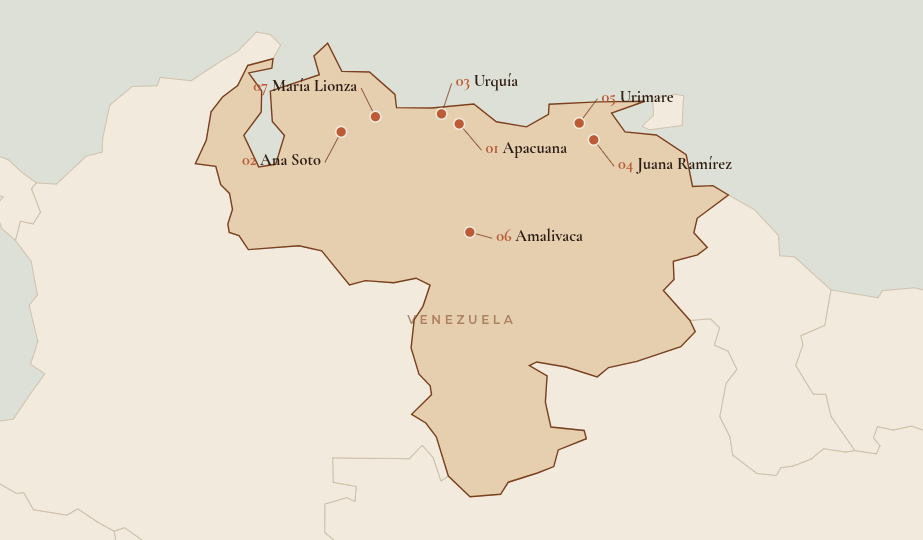
HISTORICAL FACT Active in the 1570s, Apacuana was a formidable spiritual leader (Piache) and elder of the Quiriquire people in the Valles del Tuy region. Possessing remarkable strategic intelligence, she successfully unified historically fractured tribal groups into a cohesive confederation. She orchestrated a brilliant, localized uprising that fully liberated her people’s territory from tyrannical Spanish encomenderos before colonial counter-offensives ultimately led to her capture.
THE LEGEND Oral tradition holds that Apacuana possessed a voice that could command the wind and summon jungle fauna to aid her warriors. In spiritual lore, it is believed that her unyielding spirit did not perish upon her execution; instead, she dissolved into the soil of the valley, forever anchoring native sovereignty to the landscape. Today, she is honored nationally with a monumental 7-meter statue guarding the entry highway to Caracas.
HISTORICAL FACT A 17th-century chieftain of the Gayón nation in modern-day Lara State, Ana Soto spent her early years trapped in Spanish servitude. Escaping deep into the cloud forests, she assumed chieftainship and organized an unparalleled 50-year-long guerrilla campaign. Commanding an elite army of over 2,000 native warriors, she successfully neutralized dozens of Spanish punitive expeditions. She was captured and executed by impalement on August 6, 1668.
THE LEGEND Revered by her people as the ‘Hija de la Tierra y el Sol’ (Daughter of the Earth and the Sun), myth states that Ana Soto could run faster than a Spanish warhorse and map complex trail networks using only the position of the stars. Folklore says that on the anniversary of her execution, the mountains of Lara whisper her name through the rustling of dry leaves, warning oppressors that her guerrilla army remains vigilant in spirit.
CACAO DESIGNSHISTORICAL FACT Urquía was a highly respected Caribe chieftain and the life partner of the legendary paramount chief, Guaicaipuro. Following Guaicaipuro’s tragic assassination by Spanish forces, Urquía refused to surrender. Instead, she leveraged her immense political influence to restructure the indigenous leadership, coordinating the native cavalry and reinforcing territorial defenses across the central Maracapana and Caracas valleys.
THE LEGEND It is told that when her young daughter was captured by the conquistadors to force a surrender, Urquía breached the camp herself, rescued the child, and famously declared that she would rather see her family belong to the wilderness than bow to foreign chains. In modern folklore, she is invoked alongside Guaicaipuro as a protective spirit of family unity and sovereign pride.
HISTORICAL FACT Born into slavery in 1790 to an Afro-descendant mother and a Spanish master, Juana Ramírez freed herself to join the republican rebellion against Spain. During the fiercely contested Battle of Alto de los Godos on May 25, 1813, she organized and commanded ‘La Batería de Mujeres’ (The Battery of Women), a ferocious 100-strong all-female combat and artillery unit. She earned the moniker ‘La Avanzadora’ (The Advancer) because she consistently charged directly into enemy lines, once famously capturing an elite officer’s sword mid-battle.
THE LEGACY & SCIENCE Juana’s historical impact is immense; in 2015, she became the very first Black woman officially inducted into Venezuela’s sacred National Pantheon of Heroes. Demonstrating the longevity of her cultural status, arachnologists in 2023 officially named a newly discovered, fierce species of large Venezuelan tarantula — Xenesthis avanzadora — directly in her honor.
CACAO DESIGNSHISTORICAL FACT Urimare was a 16th-century Mariche princess and the first woman formally recognized as a supreme chieftain across multiple tribes. Captured by English privateers led by Sir Walter Raleigh in 1595, she famously wounded her captor and swam to freedom. She mastered defensive warfare under Chief Guaicamacuto — who named her ‘the highest among the high’ — and led successful campaigns repelling pirate incursions on the northern coast.
THE LEGEND OF CUEVA DEL GUáCHARO To the local Chaima people, the massive subterranean limestone labyrinth of the Cueva del Guácharo represents the gateway to the underworld, where the screaming voices of the fruit-eating nocturnal guácharos (oilbirds) are believed to be the cries of their ancestors. Chaima myth dictates that at the conclusion of her earthly wars, Urimare did not die. Instead, she walked deep into the pitch-black caverns, transforming into the original, immortal Queen Guácharo. Every evening at dusk, she flies out of the cave mouth to shadow the native lands and screech warnings of incoming danger.
THE MYTH Hailing from the ancient traditions of the Tamanaco people along the Orinoco River, the myth of Amalivaca explains the creation of modern humanity. When a catastrophic global flood wiped out all of mankind, the divine creator Amalivaca and his brother survived inside a celestial canoe. Navigating to the summit of the sacred mountain, Tepui Encaramada, they instructed the final surviving human couple to cast the seeds of the sacred Moriche Palm over their shoulders into the mud below. The seeds that struck the earth immediately transformed into the brave men and women who repopulated the Venezuelan plains.
CACAO DESIGNSTHE LEGEND Central to Venezuela’s modern syncretic folklore is María Lionza, a mythical indigenous princess born with mesmerizing green eyes — a trait foretold by shamans to bring total ruin. Cast away to save her tribe, she was protected by the waters of the Montaña de Sorte. One afternoon, a colossal, primordial Anaconda swallowed her. The snake grew so swollen with her power that it literally burst, triggering a massive, landscape-shaping flood. María Lionza dissolved into the ecology of the mountain itself, transforming into the reigning goddess of the wilderness, queen of wild animals, and protector of the waters.